

- Game Typ: Hand Management, Resource Movement
- Player: 2-6
- Age: 8+
- Play Time: 45 min
- Autor: David Parlett
- Illustrator: Büttner & Plümacher
- Publisher: Ravensburger u.a.
The original „Hare and Tortoise“ or in German „Hase und Igel“ is a game from 1973 and is now one of the classics among board games.
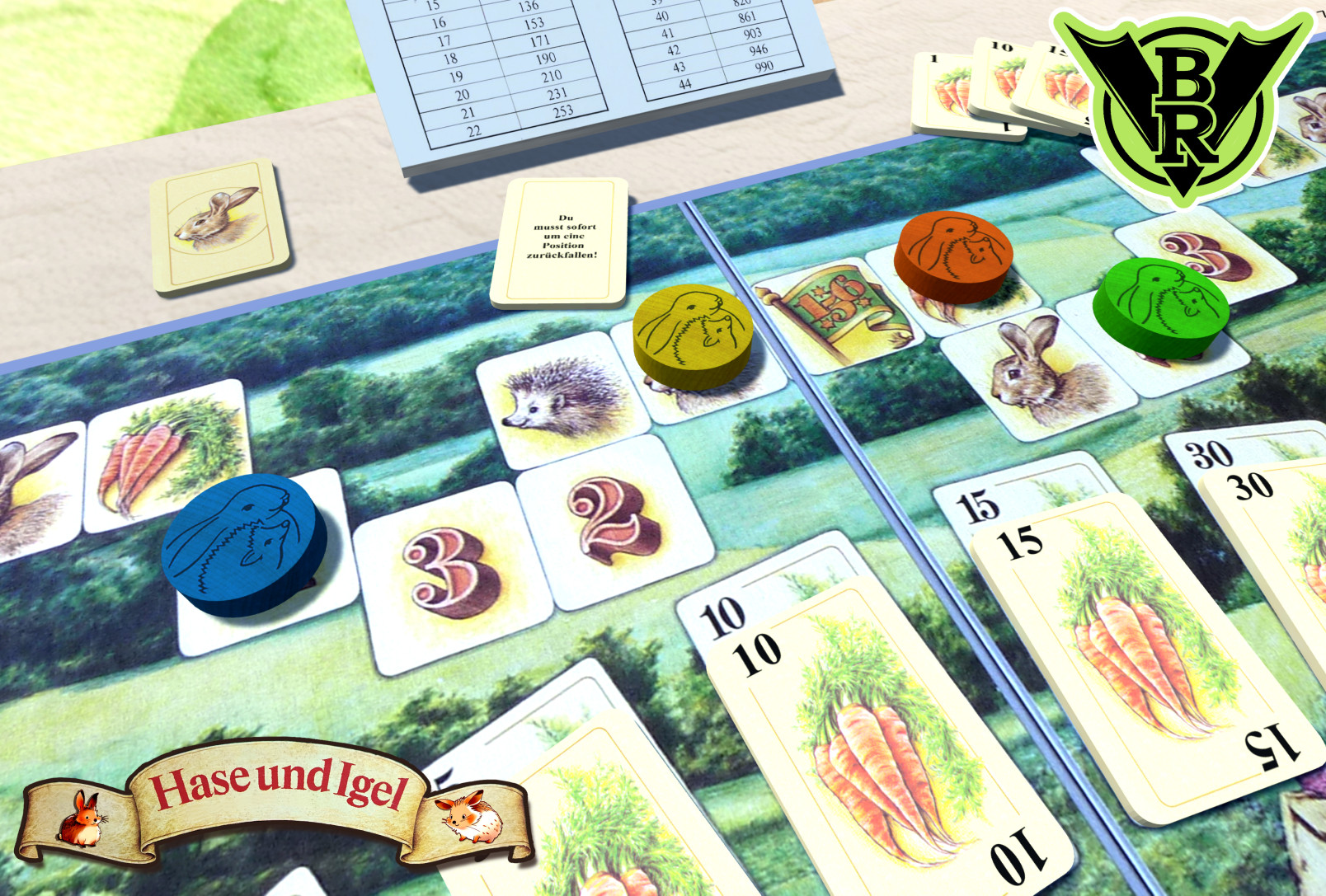


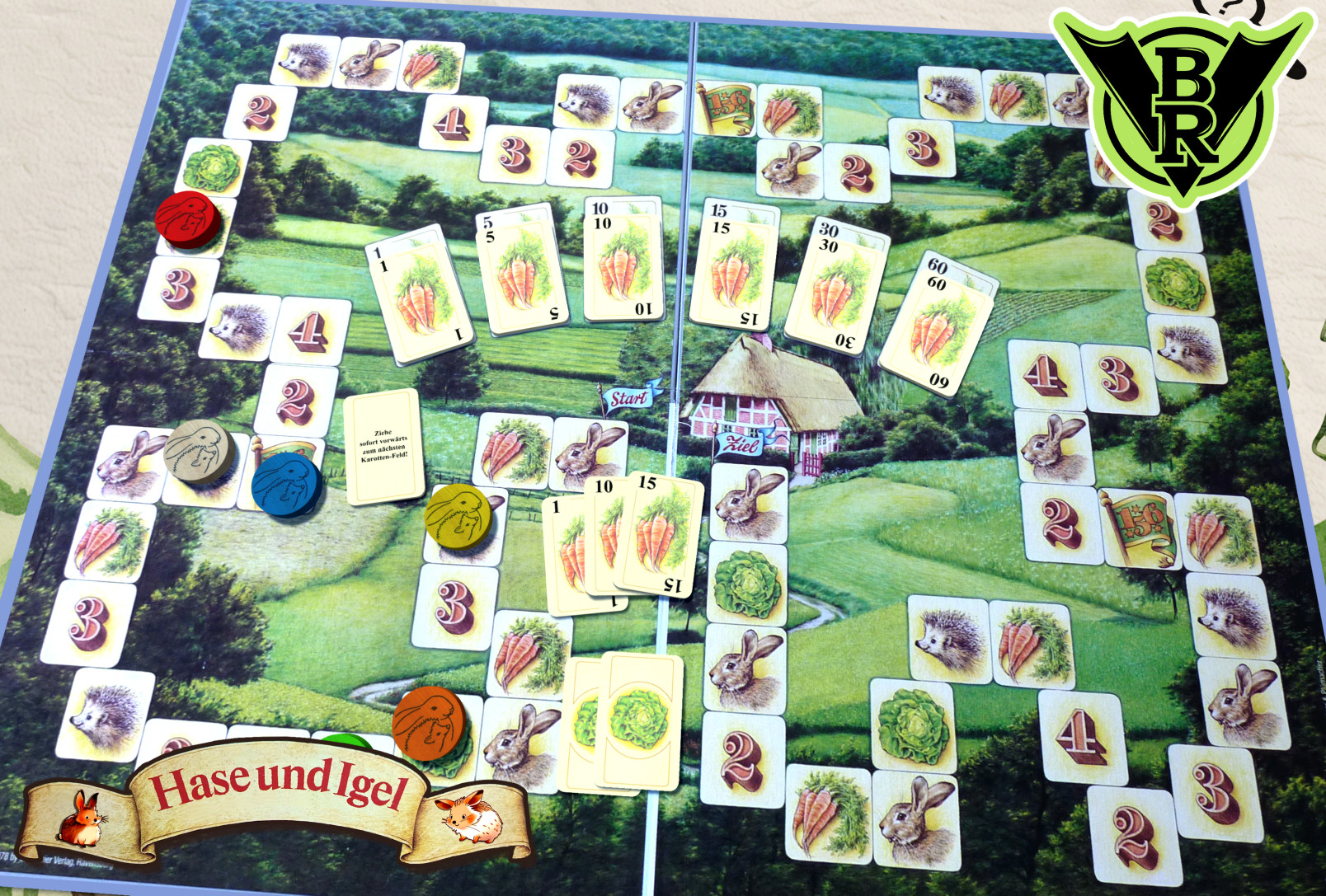

It has a very clever movement mechanism that offers several strategies for winning the game. In principle, you can move your token forwards and backwards, and the aim of the game is to be the first to cross the finish line with your piece. Moving and reaching the finish line is of course tied to certain rules. For example, it costs carrot cards if you want to make big jumps forward, whereas you get new, healthy snacks if you fall back to a hedgehog field.
Everything is set up as a kind of race, as is already suggested in the fairy tale of the same name. On the way across the fields of the game board, in addition to collecting and handing out carrots, you also have to eat all the lettuce heads, because you are not allowed to enter the goal, the farm, with these in your hand.
Managing the few different supplies is very interesting. For example, you can get vegetables from carrot fields, but you can also give them away, which is very important for certain victory conditions at the end. You need a holistic strategy for this game, as well as a little tactical skill and improvisation, for example if an opposing figure occupies exactly the field that you could use most right now. Then you have to re-plan and rethink your steps.
And as if that wasn’t enough, rabbit cards also bring with them completely unforeseen tasks, which can sometimes be used to your advantage. Not all rabbit cards have bad events waiting for the player. Last but not least, you can predict your own position in the race and if you’re right, you get a big carrot bonus.

Im Original „Hare and Tortoise“ oder auf Deutsch „Hase und Igel“ ist ein Spiel von 1973 und zählt mittlerweile zu den Klassikern unter den Brettspielen.
Es besitzt eine sehr clevere Zugmechanik die mehrere Strategien anbieten, um das Spiel zu gewinnen. Prinzipiell kann man mit seinem Spielstein vorwärts und rückwärts ziehen, wobei es das Ziel des Spiels ist, mit seinem Stein als Erstes die Ziellinie zu überqueren. Das Ziehen und das Einlaufen ins Ziel ist natürlich an bestimmte Regeln gebunden. So kostet es Möhrenkarten, wenn man große Sprünge nach vorn machen möchte, wogegen man neues, gesundes Knabberzeug erhält, wenn man sich auf ein Igelfeld zurückfallen lässt.
Alles ist als eine Art Wettrennen aufgebaut, wie es im gleichnamigen Märchen ja bereits angedeutet wird. Auf dem Weg über die Felder des Spielplans gilt es, neben dem Sammeln und Ausgeben von Karotten, auch alle Salatköpfe zu verspeisen, denn mit diesen auf seiner Hand, darf man nicht das Ziel, den Bauernhof, betreten.
Sehr interessant ist dabei das Verwalten der wenigen unterschiedlichen Vorräte. So kann man auf Karottenfeldern Gemüse erhalten, aber auch ebendieses abgeben, was für bestimmte Siegbedingungen am Ende sehr wichtig ist. Man benötigt eine ganzheitliche Strategie für dieses Spiel, als auch ein wenig taktisches Geschick und Improvisation, falls zum Beispiel eine gegnerische Figur genau das Feld besetzt, welches du gerade jetzt am besten gebrauchen könntest. Dann heißt es umplanen und seine Schritte überdenken.
Und als ob das alles nicht genug wäre, kommen mit Hasenkarten auch noch völlig unvorhergesehene Aufgaben dazu, welche man aber so manches Mal zu seinem Vorteil nutzen kann. Nicht alle Hasenkarten warten mit schlechten Ereignissen auf den Spieler. Zu guter Letzt kann man die eigene Position im Rennen vorhersagen und wenn man richtig liegt, gibt das einen satten Möhrchen-Bonus.

 Skull Crew Studios